
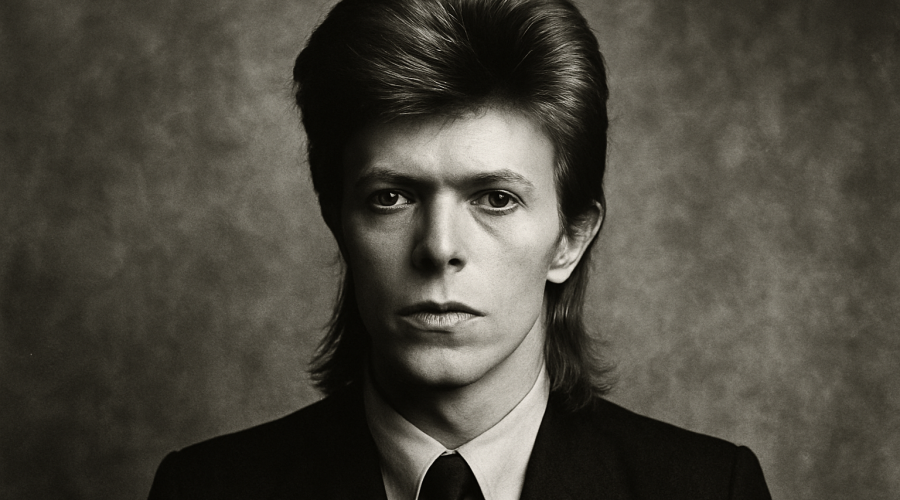
When the David Bowie Is exhibition wrapped up its five-year world tour at the Brooklyn Museum in 2018, Spotify decided to mark the occasion with something more than a standard sponsorship. As the lead sponsor, the streaming giant wanted to create a tribute that matched Bowie’s creativity and deep connection to New York City.
The result was one of the most inventive outdoor advertising campaigns in recent memory — a complete takeover of the Broadway-Lafayette subway station, transformed into an immersive museum-like experience celebrating Bowie’s life, art, and relationship with the city he called home.
Spotify’s starting point was simple but powerful: New York had always had a special bond with David Bowie. After his death, the streets of the city filled with tributes — flowers, murals, and handwritten notes — from fans who had claimed him as one of their own. Bowie had spent the last two decades of his life living in Soho, so Spotify wanted to honor that connection by turning the subway station nearest to his neighborhood into a public exhibition space.
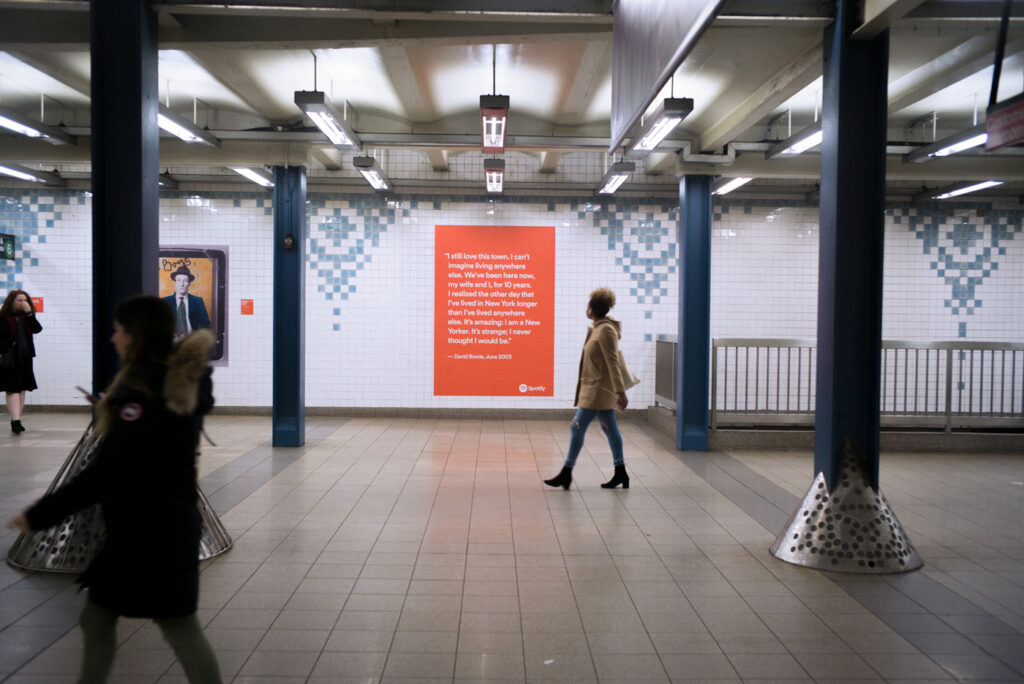
In collaboration with the Brooklyn Museum, the Bowie estate, and the Metropolitan Transportation Authority (MTA), Spotify transformed Broadway-Lafayette station into an underground gallery. For four weeks, commuters found themselves surrounded by more than 40 pieces of Bowie-related art and photography — a space that blurred the lines between advertising and cultural experience.
This wasn’t just another poster campaign. Spotify and their media partner UM went beyond traditional placements, securing every available media site in the station and gaining access to previously unused spaces, including 150-foot structural beams above stairways. The result was a curated environment that felt more like an exhibition than an ad campaign.
The creative team dove deep into Bowie’s archive, with support from the artist’s estate, to uncover materials that reflected his connection to New York. Large-format, never-before-seen photographs from legendary collaborators Mick Rock and Masayoshi Sukita lined the walls. The infamous “David Bowery” street sign — a spontaneous fan tribute graffitied during a 2016 snowstorm — was recreated and suspended from the rafters.
When research revealed that Bowie had originally envisioned Ziggy Stardust as a story set in Greenwich Village, Spotify commissioned George Underwood, Bowie’s schoolfriend and long-time illustrator, to create a new artwork imagining Ziggy wandering through a fantastical version of that neighborhood.
Every detail was considered. Museum-style description cards accompanied each piece, featuring Bowie’s own quotes about New York’s influence on his work. Spotify Codes printed alongside the displays allowed commuters to scan and instantly listen to the relevant tracks. Even the turnstiles, pillars, and stairs were wrapped in designs that extended the exhibition’s aesthetic, turning the daily commute into a multisensory encounter with Bowie’s universe.
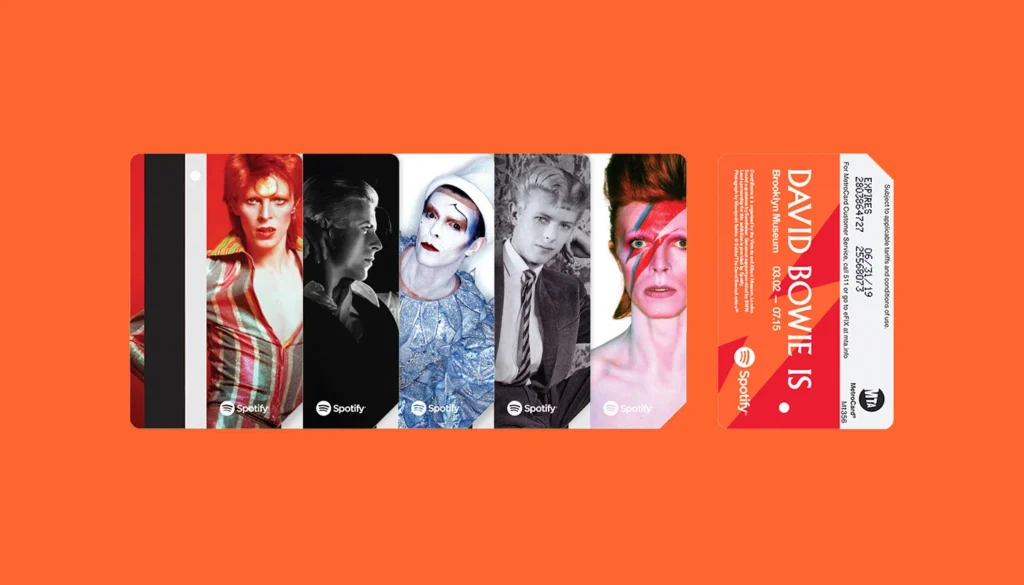
Perhaps the most talked-about feature of the campaign was the limited-edition set of five metro cards produced in collaboration with the New York Transit Authority — a rare approval. Each card represented one of Bowie’s iconic personas, from Ziggy Stardust to the Thin White Duke. Dubbed “Tickets to Mars,” the cards also doubled as entry tickets to the Brooklyn Museum exhibition. Fans queued for hours to get them, and complete sets quickly appeared on eBay for over $200.
The campaign launched in April 2018 with social media support and quickly went viral. Spotify estimated it generated $31 million worth of earned media and reached 57 million people on Instagram and Twitter within the first week. Streams of Bowie’s music on Spotify rose by 28% in New York alone, and the David Bowie Is exhibition itself drew over two million visitors.
The creative world also took notice. The project, titled David Bowie Is Here, earned five D&AD Pencils, including two prestigious Yellow Pencils for Free Format Poster Advertising and Interactive Sites Poster Advertising — placing Spotify among the top ten clients at that year’s awards.
What made this campaign stand out wasn’t just its scale, but its sincerity. Rather than relying on flashy slogans, Spotify built an experience rooted in storytelling, emotion, and cultural relevance. By reimagining an everyday public space as a place of reflection and discovery, it offered New Yorkers a chance to reconnect with Bowie’s spirit where he once walked.
As Spotify put it, “At a moment when the world was pausing to appreciate David Bowie, we provided an opportunity to uncover a portal into the genius that moves through the heart of their city every day.”