

Glydz was the first client I took on as VP of Marketing Minds. I had always handled accounts, of course, under the supervision of my Director. This time, however, there was no one to supervise me — I was the one supervising.
Our six-month partnership with Glydz was, to say the least, multidimensional. I was given the opportunity to involve myself in processes that I’ll most likely not be a part of for the next five to six years of my career. It was like a short lasting glimpse into the life of a Marketing Director.
Before getting there, though, let’s set the scene.
Glydz is a Europe-based, university-backed electric sole startup. Their goal is to revolutionize the way people commute, not by incremental improvement but through radical innovation. Two soles — one for each shoe — and a remote. It’s as simple as it is fascinating.
Products like this often face resistance. People are hesitant when it comes to solutions they’re unfamiliar with. As Claude Lévi-Strauss famously stated, “Human societies are both ethnocentric and xenophilic.” Translated into marketing language: “People are both xenophobic and xenophilic — they fear the foreign and are fascinated by it at the same time.” This was the philosophy we followed during our website design: we had to depict the novelty of the product while ensuring that viewers were not threatened by it.
Although the implementation of the website was done by the client, Tanguy’s team received a full breakdown of the features, functionalities, and content of the website. Wireframes were also created for each individual page of the website.
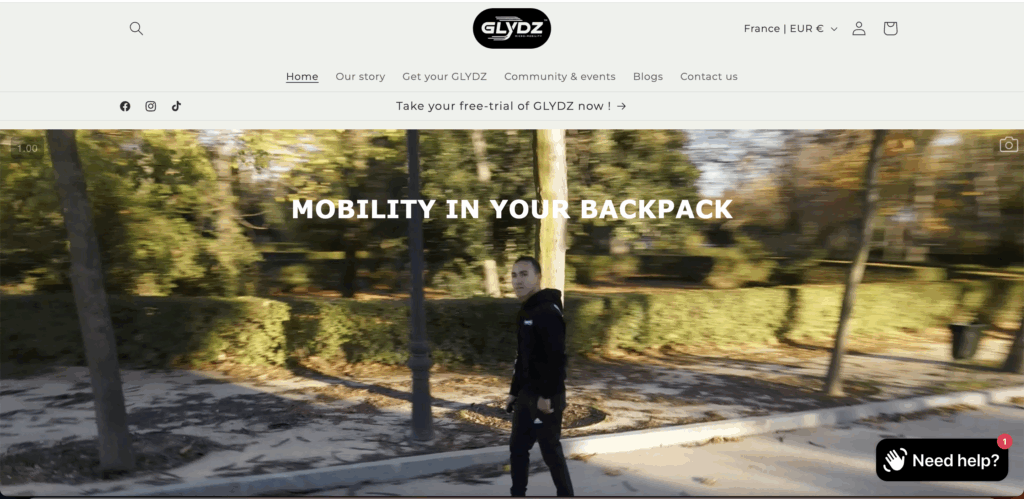
The website consisted of multiple sections depicting the ease of use of the product. Several models depicting the target audience of the brand were also displayed using the product. Finally, visitors were invited to book a trial and test drive the product – like buying a car.
The original design met initial expectations, but as the professionals that we are, we knew that success couldn’t be judged by personal taste alone. That’s where website usability tests came in. Dear reader, I don’t know if you’ve had the pleasure of experiencing this process; if you have, you know it’s long.
Along with my fantastic team, we conducted over 20 tests. To keep the results unbiased, we ensured that all the testees were unfamiliar with the brand and therefore had no pre-existing opinions about it. In each test, users were instructed to navigate the website, understand the product and its intended benefits, and finally pre-order the item. Participants thought out loud and openly shared their impressions of the product. Interestingly enough, although we expected to receive feedback only about the website, we were able to provide Tanguy with a wealth of critiques on the product, its pricing, and features as well. An insightful process indeed.
Arguably one of the most memorable moments of my year and career so far. For the first time, I was on the other side of the table. For a brief period in March, I was no longer the one being asked the questions, but the one trying to learn about candidates and understand what they could bring to the company. Arguably the best way to improve at interviewing — observe what works and what doesn’t.
We interviewed an array of candidates — most competent, some lacking technical skills, others lacking confidence or interest. Some put real effort into the take-home assignment; others simply completed it with Chat. Trust me, it shows. The work may appear satisfactory, but ask one question and the house of cards crumbles.
Take-home assignments are more than a test of ability — they reveal drive. A candidate with a sloppy but good assignment will likely produce mediocre work within your company. Choose the one who didn’t perform as well but spent ten hours on it. Skills can be taught; attitude can’t. We hired two people, both great. I’m 2 for 2 now.
Of course I must thank Tanguy for putting his trust in my young, yet developing judgement.
Like every other contemporary startup, Glydz needed a content strategy — not for the content itself, but for the creative process. What? Structure in creativity? Impossible. To this day, Glydz remains one of the few institutions I know that consciously chose to standardize its creative process — and, more impressively, did so at such an early stage. It was a challenge, but here’s what we produced:
First, we told them to steal like artists. And they did. Before creating anything, the Glydz team would find pieces of content that performed well, analyze why they did, extract the underlying principle, adapt it to their limited budget, and discuss internally.
Step 2, the ideation process. The goal: Come up with content ideas (that’s it!), define some 3-5 core themes (ex: lifestyle & culture, BTS, brand/consumer personas, etc). What worked well last month? Why did it? What new content did we find before attending this meeting? How are we going to adapt it? Once ideas for the month were collected, the team started challenging them with a set of questions:
The “Would My…” Test: Putting myself in the shoes of my audience, would I engage with it?
The “So What?” Test: Why should anyone care about this?
The Specificity Test: Is this concrete enough to be useful?
The Shareability Test: Would someone send this to a friend?
The Brand Test: What does this say about our brand?
The Timing Test: Is this relevant right now?
With all the ideas collected, scripts could be written in advance, and the team now knew which shots they needed from their filming sessions. Tanguy no longer had to commute three times a week to film; it became a once-every-two-weeks process.
Overall, the above project is a testament to how well an agency can work with an open minded client. Tanguy and his team were open to all sorts of criticism, and that’s where all their growth came from.
Once again, a big thank you to my team, Soumya and Trisha, and to Mahima for her on-going guidance.